
The Clarity Blueprint FAQs answer common questions about the method, books, workbooks, student use, languages, guided learning, and how the framework supports clarity, confidence, purposeful action, and lifelong growth.
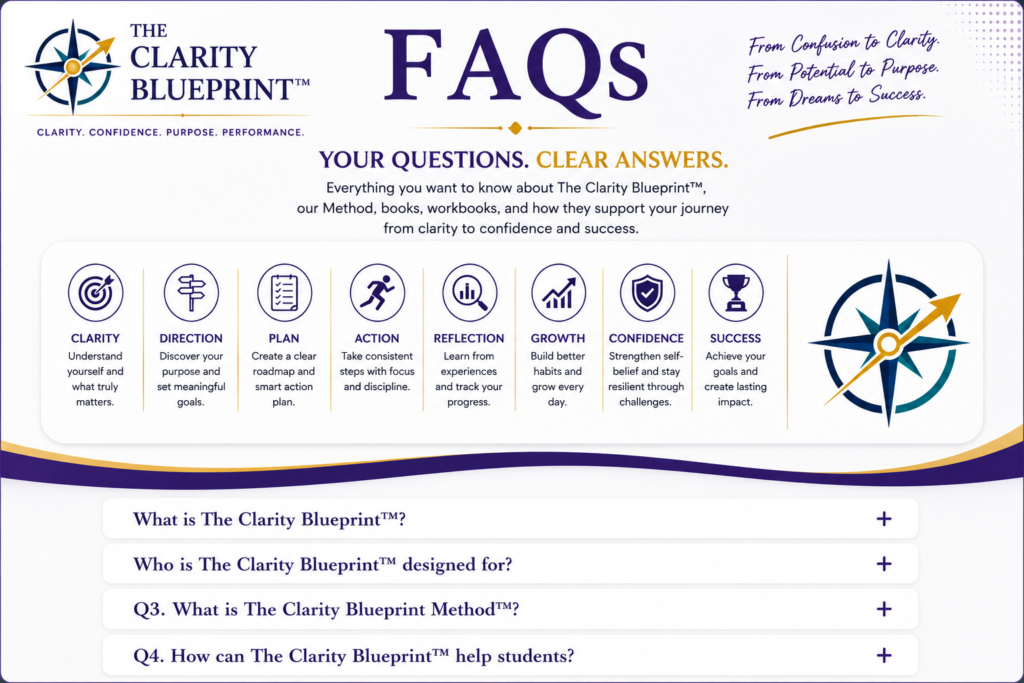
The Clarity Blueprint™ is a practical student-development framework designed to help students gain clarity about themselves, their goals, and their direction. It guides them from self-awareness and clear thinking to purposeful action, consistency, confidence, and long-term growth.
The Clarity Blueprint™ is primarily designed for students who want greater clarity, confidence, direction, consistency, and purpose in their academic and personal journey. Its principles can support students at different stages of learning and can also help parents and educators better understand the process of student growth.
The Clarity Blueprint Method™ is a structured approach to student development built around ten interconnected stages: Gratitude, Self-Awareness, Clarity, Direction, Goals, Action, Reflection, Consistency, Growth, and Purpose. The method helps students move beyond simply setting goals and develop a practical process for turning those goals into meaningful action.
The Clarity Blueprint™ helps students understand themselves better, identify what they want to achieve, set meaningful goals, create actionable plans, build consistency, reflect on their progress, and develop greater confidence. The emphasis is not only on academic performance but also on developing habits and thinking patterns that support lifelong growth.
No. The Clarity Blueprint™ is designed for students at different levels of academic performance. A student may be struggling with direction and consistency, performing at an average level, or already doing well and looking to improve further. The framework begins with understanding the individual student rather than comparing them with others.
No. Academic improvement is important, but The Clarity Blueprint™ takes a broader view of student success. It focuses on clarity, self-awareness, goal setting, action, reflection, consistency, confidence, personal growth, and purpose—skills that can support students both during their education and beyond it.
Traditional study advice often concentrates on techniques such as timetables, revision, note-making, and examination preparation. The Clarity Blueprint™ begins at a deeper level by helping students understand themselves, establish direction, define meaningful goals, and build a consistent system of action and reflection. Study techniques then become part of a larger personal-development framework.
The Clarity Blueprint for Students is a practical student-development book by Lalit Kumar Mishra. It provides a structured roadmap to help students develop clarity, confidence, meaningful goals, consistent action, and habits that support academic and lifelong success.
Yes. The Clarity Blueprint™ workbook complements the main book through practical exercises, reflection activities, goal-setting tasks, and a 30-Day Clarity Challenge. It is designed to help students apply the ideas rather than simply read about them.
The 30-Day Clarity Challenge is a structured part of The Clarity Blueprint™ workbook that encourages students to practise clarity, reflection, purposeful action, and consistency over 30 days. Its purpose is to help students turn ideas into regular behaviour through small, meaningful daily actions.
Yes. Although the framework is primarily student-focused, parents can use its principles to better understand their child’s goals, challenges, habits, and development. It can provide a constructive framework for conversations about progress, responsibility, confidence, and future direction.
Yes. Educators can use the principles of The Clarity Blueprint™ to encourage self-awareness, goal setting, reflection, consistency, responsibility, and purposeful learning among students. The framework is intended to complement academic teaching rather than replace it.
The Clarity Blueprint Method™ was created by Lalit Kumar Mishra, an educator, student success mentor, author, and Founder of Topper Formula. The framework draws upon more than 20 years of teaching and mentoring experience with students.
Yes. The Clarity Blueprint™ and Topper Formula share a common educational philosophy centred on helping students develop clarity, confidence, consistent action, and meaningful progress. Topper Formula focuses strongly on academic learning and student performance, while The Clarity Blueprint™ provides a broader framework for student development and lifelong growth.
ou can explore this website to learn about The Clarity Blueprint Method™, the books and workbooks, resources for students, and future programmes and initiatives. As new resources become available, they will be added to the website.
For the best experience, students are encouraged to follow The Clarity Blueprint™ in sequence because each stage builds upon the previous one. The journey progresses from understanding yourself and gaining clarity to setting goals, taking action, reflecting, building consistency, growing, and ultimately developing a stronger sense of purpose.
Yes. The Clarity Blueprint™ addresses common challenges such as lack of direction, inconsistent action, procrastination, and difficulty maintaining productive habits. Rather than relying only on motivation, it encourages students to develop clarity, purposeful daily action, reflection, and consistency so that progress becomes more systematic and sustainable.
The Clarity Blueprint™ books and resources are being made available through selected online platforms and official channels. You can visit the Books & Workbooks and Resources sections of this website for current information, available editions, and access to supporting materials.ucators better understand the process of student growth.
Still Have Questions About The Clarity Blueprint?
Explore The Clarity Blueprint FAQs above for answers about the framework, resources, books, workbooks, and student journey. As new resources and guided learning programmes are introduced, this page will continue to provide clear and useful answers.